From a changing energy sector to personal career transformation
Latvia’s annual Career Conference brings career practitioners together to exchange ideas and experience, and recognises special achievements in career guidance through awards. This year’s energy theme offered a concrete starting point for a wider discussion: how do we prepare people for industries that are changing, help young people make informed first choices, and support those reconsidering an established professional direction?
Across the presentations and workshops, I saw a connection between labour-market change, the organisation of career learning, and the personal experience of making decisions under uncertainty. My participation was made possible through cooperation between the Estonian and Latvian Euroguidance centres, which grew into a valuable exchange of experience in Riga.
The energy sector: demand needs an educational pathway
Gunārs Valdmanis, Director of the Energy Market Department at Latvia’s Ministry of Climate and Energy, explored careers in energy from the perspectives of employees, employers and educational institutions. His presentation highlighted growing demand for specialists alongside difficulties attracting enough students into relevant education.
The sector also competes with ICT, engineering, electronics and construction for people with overlapping competencies. Alongside technical knowledge, the presentation emphasised advanced digital skills, cybersecurity and the integration of renewable energy. Interdisciplinary cooperation, understanding energy law and economics, and making decisions in difficult situations also featured among the skills needed.
These developments raise relevant questions for Estonia. The 2026 OSKA energy-sector study forecasts a need for approximately 5,000 entrants from formal education over 2025–2035, covering both replacement needs and employment growth. Employment in the sector’s core occupations is projected to increase by nearly 2,000. Attracting interest is only part of the challenge: completing education, acquiring relevant competencies and entering sector employment also matter.
One example I noted during the conference concerned strengthening mathematics and physics during the first two years of university to address gaps in students’ secondary-school preparation. It brought the connection between career aspirations and educational readiness into focus. Encouraging young people to consider energy careers needs to go alongside helping them understand and prepare for the learning involved.
For career practitioners, this means exploring both opportunities and the routes into them. Which competencies can someone bring from another field? What additional learning will they need? What support could help them succeed? The overlap between sectors creates possibilities for movement, while the requirements of each occupation need careful consideration.
These questions also lead naturally to the role of schools: how can career activities help young people build an informed understanding of work and connect it with their own educational choices?
From individual events to connected career learning
Lithuanian educator and career expert Laurynas Puidokas explored how schools organise career guidance. His presentation and workshop asked why students can attend career fairs, company visits and other activities yet still struggle to decide what to do after school.
His central argument was that these experiences need connections. Students need support to prepare for an activity, interpret what they encounter and use what they learn in a subsequent decision.
The approach he presented was straightforward: prepare a question or prediction, collect evidence during the activity, reflect afterwards and identify a next action. A company visit becomes an opportunity to test an assumption about work. A study fair becomes a chance to compare routes against personal criteria. An interests questionnaire becomes a starting point for finding real examples that support or challenge its results.
Schools can begin with an activity they already organise, adding a short preparation task and a reflection afterwards. The important step is to use the resulting learning again, whether in a lesson, a counselling conversation or the next career activity.
This also changes the expectation placed on young people. The aim is an informed first step after school, with the understanding that directions can change. Schools can provide a structure through which students practise choosing, acting, receiving feedback and adjusting.
For me, this connected directly with the energy-sector discussion. Information about changing industries becomes useful when young people have opportunities to interpret it in relation to their interests, capabilities and educational choices.
Career transformation and professional identity
Dr Anita Gaile’s keynote brought the discussion to the personal experience of career change. She described six forms of transformation: promotion to the next management level, moving between departments, joining another organisation, becoming an entrepreneur, changing profession and changing yourself. This widened the discussion beyond a change of occupation to include transitions within an organisation and changes in how we understand ourselves.
Her presentation connected professional identity with relationships and life stage. Career decisions take place within a life that may already include established responsibilities, expectations and connections. A new direction can therefore raise questions about who we are, where we belong and how work fits into the rest of our lives.
Anita’s emphasis on reviewing underlying assumptions resonated with my own exploration of professional identity. When we closely identify with what we do, recognising that our skills could be useful elsewhere may be easier than imagining ourselves in that unfamiliar setting. Her image of a caterpillar becoming a butterfly illustrated the extent of the change: a new professional identity may require us to reconsider assumptions that served us well before.
The transformation process she presented moved from dissatisfaction through exploring personal needs and making a decision to building a new professional identity. The distinction between deciding and building felt particularly relevant. Choosing a direction can release energy for action, while developing confidence and a sense of belonging in a new role takes time. Anita emphasised the need for space, the capacity to spend some of the journey alone, and support from mentors, coaches, therapists and fellow travellers.
I saw a connection here with Laurynas’s approach to career learning. Young people need opportunities to interpret experiences and revise assumptions as they make their first choices. Adults navigating a transition may need a similar process, while also reconsidering an established sense of professional self.
Fear, uncertainty and the next step
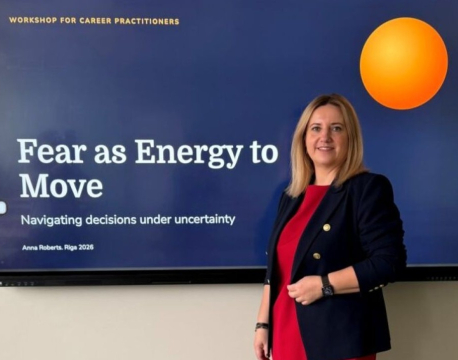
My workshop, Fear as Energy to Move, followed Anita’s keynote and picked up where it left off: the fear and uncertainty that can arise when a meaningful change comes within reach. Participants worked with a decision from their own lives. They separated what they felt, what they knew and what they were assuming, then looked at what taking the step might cost and what not taking it might cost. The underlying idea is that some of the information we want before deciding only becomes available through experience. For career practitioners, this means helping people find a step that is manageable enough to attempt and meaningful enough to learn from.
For me, the conference brought these different levels of career guidance together. Knowledge of changing sectors helps us understand where opportunities may develop. Connected career learning helps people explore those opportunities and prepare for their demands. Attention to identity, fear and uncertainty helps us support the person making the transition. Whether someone is choosing an initial educational route or redefining an established career, our work is to help them find a considered next step and the support to take it.
Author: Anna Roberts, Estonia