Alumni as a Connecting Link between Lifelong Learning and Career Guidance
Author: Euroguidance the Netherlands
Alumni form a natural bridge between Lifelong Learning and Career Guidance. While career guidance traditionally focuses on supporting learners in making educational and career choices, lifelong learning is concerned with the continuous development of knowledge, skills, and competencies throughout life. Alumni engagement connects these two domains by enabling educational institutions to continue supporting graduates beyond the point of graduation and throughout different stages of their careers.
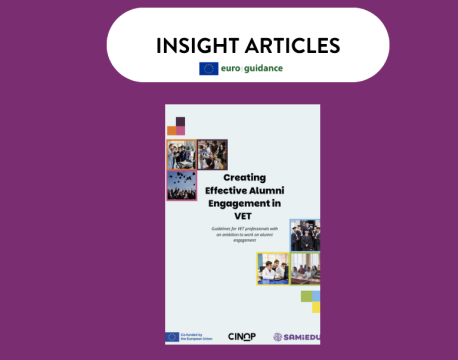
This perspective was explored in the Erasmus+ project Effective Alumni Policies and Practices in Finland and the Netherlands, which examined how educational institutions can build sustainable and mutually beneficial relationships with their graduates. The project resulted in a set of practical guidelines and recommendations for strengthening alumni engagement. The reflections and recommendations presented here are based on those findings and illustrate how alumni can contribute to stronger connections between education, lifelong learning, career guidance, and the labour market.
In a rapidly changing labour market, continuous development has become increasingly important. Kuijpers and Draaisma (2019) describe lifelong learning as the lifelong and proactive development of qualities and competencies that contribute to sustainable employability, personal fulfilment, and participation in society. Educational institutions are important partners in this process, not only for current students but also for graduates seeking to navigate career transitions and changing labour market demands.
Alumni can create significant value for both education and employment. They often act as role models, near-peer mentors, guest speakers, and ambassadors, helping students gain insight into career paths, professional transitions, and workplace expectations. Through their networks, alumni can facilitate internships, work placements, and employment opportunities, while also providing valuable feedback on labour market developments (Rodriguez & Garcia, 2020). Research has shown that alumni engagement can strengthen students' career development and enhance connections between educational institutions and employers (Fung, 2022; Rodriguez & Garcia, 2020).
The relationship is reciprocal. Alumni themselves benefit from continued access to learning opportunities, professional networks, coaching, and further education. In this way, alumni engagement not only supports current students but also creates opportunities for graduates to continue developing throughout their careers, reinforcing the principles of lifelong learning.
Alumni policy can be defined as the set of strategies and practices through which institutions develop sustainable, mutually beneficial relationships with graduates (Iskhakova et al., 2016). Effective alumni engagement contributes to educational quality, labour market alignment, and lifelong learning opportunities (Lifelong Learning, 2018; De Grip & Pleijers, 2019; De Grip, 2021). Alumni themselves represent a diverse group. While the term is typically associated with graduates from formal education programmes, it may also include participants in short courses and non-formal learning programmes (McDearmon, 2013). As such, alumni constitute a valuable community of knowledge, experience, and professional networks (Rodriguez & Garcia, 2020).
Findings from the Erasmus+ project revealed differences between Finland and the Netherlands. In Finland, alumni engagement is often still driven by local initiatives and individual commitment. In the Netherlands, alumni policies are more frequently embedded within institutional strategies, although successful implementation remains dependent on active support from programme teams, staff, and management.
The project also highlighted the importance of engaging alumni early. While Finnish institutions often focus on recent graduates, Dutch institutions increasingly involve alumni throughout the student journey, including during orientation and introductory activities. This strengthens students' sense of belonging to their programme, profession, and future alumni community.
Several success factors emerged from the project:
- Embed alumni engagement strategically, with clear goals, responsibilities, and long-term commitment.
- Engage alumni throughout the student lifecycle rather than only after graduation.
- Build support among teachers, programme leaders, management, and support staff.
- Start with pilot initiatives and scale up successful practices.
- Ensure that alumni activities create value for both graduates and the institution.
As labour markets continue to evolve, alumni should no longer be viewed simply as former students. Instead, they can be seen as active and strategic partners who contribute before, during, and after a programme. By investing in meaningful alumni engagement, educational institutions strengthen the connection between education and employment, support lifelong learning and career guidance, and create learning communities in which students, alumni, educators, and employers continue to learn from and inspire one another.
The full guidelines, including detailed recommendations and practical examples, can be downloaded here.