Educational and Career Guidance in Rural Areas: Academia course in north Iceland
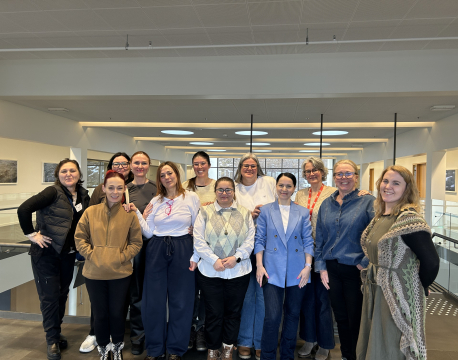
After a long break Iceland returned to the Academia programme this year and offered a course on Educational and Career Guidance in Rural Areas. The course took place on March 10–13 and was organized by the Association of Educational and Career Counsellors in Iceland, with support from the Euroguidance Centre in Iceland.
Ten educational and career counsellors from Norway, France, Switzerland, Latvia, Ireland, Luxembourg, Spain, Germany, Sweden, and Romania attended the course.
The course focused on how to strengthen educational and career guidance in rural areas. Its aim was to enhance participants’ skills in providing practical guidance in smaller communities and remote regions, for example through the use of digital technology and service innovation.
Particular attention was given to the main challenges and opportunities involved in providing guidance outside urban areas, both in Iceland and in a broader European context. Participants explored different systems and practices across countries and worked on ideas for projects that promote equal access to guidance regardless of place of residence.
The course included a visit to the University of Akureyri which offers various programmes including social sciences, nursing, occupational therapy, teacher training, biotechnology, law, police science, psychology and fishery studies. Distance learning is one of the focus points of the University which has a policy of serving students living all over Iceland.
The Academia participants attended a University Day event, received information about student counselling services, toured the campus, and worked on a project related to the “Next Step” web portal which provides information on education and careers in Iceland.
The group was warmly welcomed at a visit to the upper secondary school Laugar, which is a rural boarding school and then travelled to the town of Húsavík where they visited the Húsavík Academic Center (HAC). The centre is dedicated to promoting and facilitating lifelong learning. The staff presented the organization’s activities and discussed the importance of lifelong learning for the local labor market, as well as projects related to study pathways and validation of prior learning. The group also received an engaging introduction to the Húsavík Fab Lab.
During Academia participants got the chance to observe the work of counsellors in action at the Eyjafjörður Lifelong Learning Centre and at the Akureyri Vocational School.
The course concluded with a panel discussion on the importance of educational and career guidance in rural areas. María Jónsdóttir, counsellor at the University of Akureyri, Hekla Pálmadóttir, an occupational therapy student at the university, and Sindri S. Kristjánsson, director of the Rector’s office and a candidate for the Social Democratic Alliance in the upcoming municipal elections in Akureyri, delivered very interesting presentations. This was followed by productive discussions on next steps in developing guidance services that can ensure equal access to information and support for educational and career choices, regardless of where people live.