One Step to Reality: How VR Technologies Are Changing the Approach to Choosing a Profession
Author: Anna Puhachova – Career Counsellor, Ambassador of the National Europass & Euroguidance Centres in Ukraine, Director of the NGO “European Social and Economic Institute”.
The field of career counselling is changing rapidly: traditional tests and lengthy consultations are gradually becoming a thing of the past, while ordinary AI chats or career bots can hardly surprise anyone today. This is why European career guidance practice is taking the next step by actively integrating immersive technologies and turning virtual reality (VR) into an effective working tool. This offers a unique chance both for young people taking their first steps in the labour market and for professionals planning a radical change in their qualifications to safely test their career hypotheses. However, in order for this tool to be truly beneficial, it is important to understand not only its advantages, but also its clear limitations.
How does virtual "job shadowing" help to evaluate a profession in practice?
Traditionally, acquaintance with a profession involves searching for information on the Internet, watching videos, or, at best, short visits to workplaces. This lack of reliable practical experience means that young people often make a "blind choice" of a profession – relying on stereotypes or guided exclusively by the advice of their parents, which may not reflect the realities of the modern labour market. Organising a full-fledged internship requires significant resources and logistical arrangements with employers. However, virtual reality offers a fundamentally different, deeper level of engagement through digital "job shadowing" – a format of following and observing a specialist directly during their work.
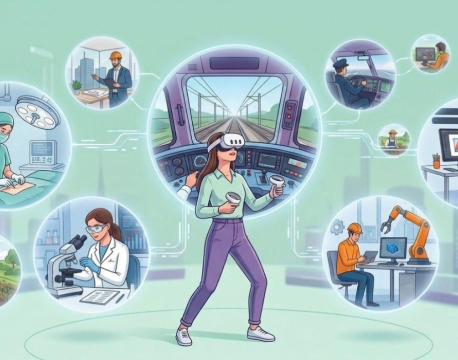
The user has the opportunity to experience the professional context, rather than just being a passive observer. Thanks to VR programmes, a person can find themselves in the cab of a train driver, inside a high-tech logistics hub, an ordinary hospital or a modern medical laboratory in a matter of minutes. This technology enables users to evaluate the visual and aural aspects of the workplace, including the intensity of lighting, the level of background noise, and the general pace of work.
The main value of this approach lies in demonstrating the routine. A person can see daily processes without promotional embellishments, which helps to dispel romantic myths about the potential job. It also enables to get prompt answers to key questions, such as whether this format of daily activity is comfortable, whether it matches their temperament, and whether it is worth investing time in obtaining the appropriate qualification.
What aspects of real work cannot be reproduced in a virtual environment?
Despite the impressive level of detail in modern digital simulations, VR is still just a simulator. There are fundamental components of professional activity that technology is currently unable to reproduce or measure reliably.
Firstly, the VR environment does not allow for an objective assessment of emotional intelligence, empathy and complex communication skills. For professions based on constant interaction with people, such as social work, teaching and psychology, the ability to build trusting interpersonal relationships is critical. Not even the most perfect virtual avatar will be able to reproduce micro-expressions, body language or genuine human reactions when resolving unpredictable conflicts. Digital colleagues or clients act in accordance with prescribed algorithms, whereas real work always requires flexibility and intuition.
Secondly, the simulation completely disregards the factors of physical and psychological fatigue. A short session in VR glasses does not give any idea of how a specialist will feel after a full working day or after prolonged emotional tension. The virtual space protects the user from real stress, the fear of making a mistake, or taking responsibility for a real-life results.
Conclusion
Virtual reality is a powerful tool for making informed career choices. It makes the career guidance process more accessible, dynamic, and visual, enabling users to swiftly reject unsuitable options. However, digital testing should never be the sole criterion for making a decision. T Career planning is most effective when technological innovations are combined with live communication, self-reflection, and testing one's skills in the real world.