The G.M. Method of Student Assessment as a Tool for Developing Professional Competencies
Author: Dr. Gholamali Mohammadifard, Director, Center for Psychological Counseling and Career Guidance
What if an exam involved not only answering the professor’s questions correctly, but also formulating the questions yourself, developing your own answers, assessing your own performance, and finding out how your peers assess it?
Based on this idea, the G.M. Method transforms traditional assessment into a process in which students play an active role.
The method was developed and has been implemented since 2014 by Dr. Gholamali Mohammadifard in courses taught at the Faculty of Social Sciences and Education of the Free International University of Moldova. Experience gained through the application of this method shows that the assessment process can be used not only to evaluate acquired knowledge but also to develop competencies that students will later use in their professional lives.
The distinctive feature of the G.M. Method lies in a shift in perspective: the exam also becomes an exercise in self-awareness, communication, argumentation, decision-making, and taking responsibility. Students are placed in situations similar to those they may encounter in their professional lives: they must select relevant information, formulate and defend an opinion, assess their own performance, provide feedback, and accept being assessed by others.
The following section describes how the G.M. Method is implemented and the competencies developed at each stage.
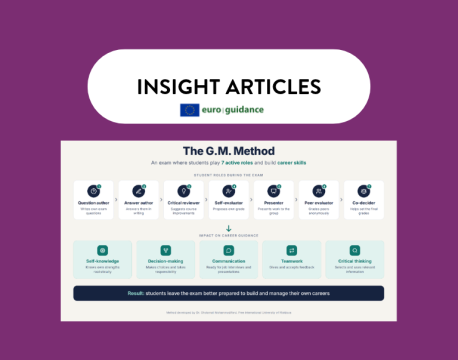
In the first stage, each student individually formulates questions based on the course content studied. This activity develops the ability to identify relevant information, as well as to select and prioritize it. The student then, at the professor’s request, selects several of the questions formulated and provides comprehensive written answers. This stage fosters critical thinking, the logical structuring of information, argumentation, and clear expression – competencies that are transferable to problem-solving, justifying decisions, and professional communication.
The student then formulates several views on the course content and delivery, including suggestions for improvement. This critical analysis develops reflection, the ability to adopt and support a reasoned position, and the capacity to provide constructive feedback – skills relevant to adaptation and collaboration in professional settings.
In the final question of the written assessment, the student determines the grade they believe they deserve for their performance on the exam.
Self-assessment fosters self-awareness, personal responsibility, and a realistic appraisal of one’s own competencies. During the oral stage, students are invited, one at a time, to present their own questions and answers to the group. This experience develops oral communication, argumentation skills, confidence in expressing one’s ideas, and the ability to present one’s own work – competencies that are valuable in job interviews, professional presentations, and teamwork.
During the presentations, peers anonymously assign a grade to each participant. This peer assessment familiarizes students with assessing the performance of others, applying shared criteria, taking responsibility for the feedback they provide, and accepting different perspectives. The professor conducts a separate assessment, taking into account the written answers, the oral presentation, and the student’s overall participation throughout the course.
Finally, the students select three representatives, ensuring that both genders are represented, to join the professor in the final evaluation meeting. The final grade is determined on the basis of both the professor’s assessment and the peer assessments.
Consequently, the G.M. Method approaches the exam as a process in which students successively assume multiple roles: author of questions, author of answers, evaluator of their own work, presenter, and peer evaluator. In this way, the exam becomes not only a means of assessing knowledge but also a practical exercise that prepares students to build and manage their own career paths.