The Use of Virtual Reality for Career Exploration in Shortage Occupations
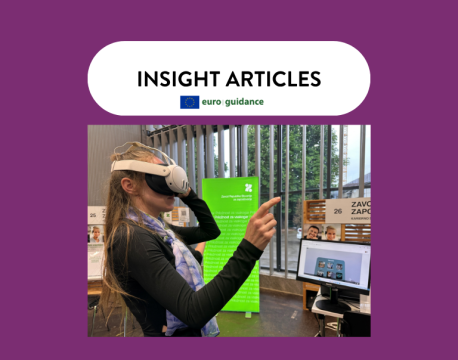
With the labour market constantly evolving and increasing skills shortages across various sectors, effective career guidance is vital for unemployed individuals and young jobseekers. These co-horts of people are often in the early stages of their career development and often lack direct insight into professional environments.
Virtual Reality (VR) technology offers an innovative and engaging approach to career exploration by providing immersive, experiential learning opportunities that support informed career decision-making. A VR-based career exploration tool was developed within the Interreg Slovenia–Austria 2021–2027 project Centre for Deficit Occupations with Virtual Reality (CDO-VR), implemented in partnership with the Employment Service of Slovenia. The goal is to promote six occupations that face labour shortages in both Slovenia and Austria. Examples include cooks, electricians, metalworkers/welders, social caregivers, system administrators and bricklayers. The tool provides a valuable insight into professions that are essential to the functioning of the labour market. Using VR in career exploration has a lot of advantages. In this article we explain four of them:
- VR as a tool for experiential career learning
- Contribution to informed career decision-making
- Enhancing engagement and motivation
- Promoting shortage occupations
VR as a Tool for Experiential Career Learning
VR enables users to experience realistic, simulated work environments through immersive technology. By using VR headsets, individuals can observe and interact within different professional contexts, gaining an insight into the nature of specific occupations. Each experience includes a 360-degree representation of a real workplace, followed by interactive tasks and guided challenges that encourage active participation. This combination of observation and hands-on engagement creates meaningful learning experiences and allows users to better understand workplace requirements and everyday job tasks.
Contribution to Informed Career Decision-Making
One of the principal advantages of VR-based career exploration is its ability to support informed and evidence-based decision-making. By experiencing job tasks and work environments, users can develop a more accurate understanding of occupational requirements and working conditions. These insights help reduce uncertainty associated with career choices, misconceptions about occupations, and aligns individual expectations with labour market realities.
This is particularly important for individuals considering entry or re-entry into the labour market, where incorrect assumptions may lead to unsuitable career paths or early withdrawal from training programmes.
Enhancing Engagement and Motivation
The immersive nature of VR enhances engagement and motivation by enabling active participation in simulated work scenarios. It improves attention and knowledge of retention while sparking curiosity about less familiar careers. At the same time, VR provides a safe and controlled environment in which users can explore occupations without real-world consequences, experiment freely, and learn at their own pace. This approach reduces anxiety, supports confidence-building, and makes career guidance more dynamic and accessible, particularly for younger individuals and those who are less engaged in traditional learning environments.
Promoting Shortage Occupations
VR is particularly effective in promoting occupations facing labour shortages, many of which suffer from limited visibility, outdated perceptions, or a lack of understanding among potential jobseekers. By realistically presenting workplace dynamics and everyday tasks, VR increases awareness of these professions and encourages consideration of career paths that might otherwise be overlooked.
Relevance for Career Guidance
The application of VR in career guidance is particularly valuable for unemployed individuals, who benefit from increased exposure to new career opportunities and a clearer understanding of potential career transitions, as well as for young jobseekers, who gain early insight into labour market realities and can make more informed educational and vocational choices. In both cases, VR supports the development of self-awareness, confidence, and proactive career planning.
VR represents a significant advancement in the field of career guidance and could be applied more broadly in future career guidance work. By facilitating experiential learning, improving understanding of the labour market, and enhancing user motivation, VR contributes to more informed career decisions and supports individuals in navigating an increasingly complex labour market.
Author: Teja Hižman, Coordinator of Career Centres at the Employment Service of Slovenia
Photo: Teja Hižman