The Origins of Career Counselling: How a Profession Was Born
Author: Viktoriia Safronova, career counsellor, Ambassador of the National Europass and Euroguidance Centres in Ukraine
Choosing a Vocation
Career Counselling, as we know it today, integrated, person-centred, and focused on the holistic life path, is a relatively young profession.
In a little over one hundred years, the field has come a long way, from a simple concept like “where to go to work” to a comprehensive support system. Psychology, coaching, assessment tools, and digital services have enriched it. But to understand where we are heading, it is important to look back at those who stood at the very beginning. At the pioneers and visionaries who genuinely cared.
The need to help others find their career paths emerged when the world began to change rapidly. Industrialisation, the rise of mass education, and the formation of a labour market made people think not only about survival, but about conscious choice.
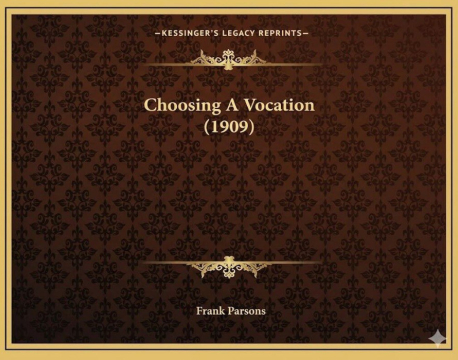
The start of the profession is usually dated to 1909, when the book Choosing a Vocation was published in the United States. It was based on the manuscripts, notes, and lectures of Frank Parsons and became the first scientific foundation of career counselling.
Driven by a curiosity for the field’s origins and a respect for those dedicated to social impact, the author of this article turned to this book to explore the story of Parsons and his Vocation Bureau.
However, another important event preceded the opening of the Bureau. In 1901, the well-known philanthropist Pauline Agassiz Shaw, also known as Mrs Quincy A. Shaw, founded the Civic Service House in Boston, USA. Its mission was to support young people and migrants arriving in the city in search of a better life, helping them find decent work and access education and training. There, in 1905, Mr. Parsons led one of the educational programmes.
Frank Parsons, the founder of Career Counselling.
Frank Parsons was not only a person of great curiosity and the true founder of the profession, but also a very interesting and multi-talented individual. The following facts speak for themselves:
- He was called a "renaissance man" – someone whose curiosity and versatility spanned multiple fields of expertise.
- A trained civil engineer, he lost his job when a railway company collapsed during an economic crisis. This personal setback proved transformative – the struggle to find and keep work became a defining moment that shaped his understanding of labor and economic inequality.
- He passed the bar exam, started a legal practice, and a publishing business.
- He worked as a teacher and lecturer at Boston University, supported general education, and campaigned for social protections for workers. These were very radical ideas for that time.
In modern terms, Parsons had a portfolio career.
In 1908, he founded The Vocation Bureau in Boston. Its services were usually free or provided as part of a social mission, mainly for economically vulnerable groups.
Four key ideas that are still relevant today
At the Vocation Bureau, Parsons developed four foundational concepts that remain the gold standard today.
- Talent Matching
He believed that people and jobs should not be matched randomly, but through a conscious understanding of individual talents. When individual capabilities align with occupational requirements, it leads to greater satisfaction, effectiveness, and success.
The core philosophy is simple: recognizing that every person is unique and every occupation has specific requirements, guidance could scientifically bridge this gap to ensure optimal professional matches.
This approach is the basis of modern competence-based and skill-matching systems such as O*NET https://www.onetonline.org/ and ESCO https://esco.ec.europa.eu/en.
- Parsons’ Triad
The triad defines the framework for a balanced and successful career path:
- deep self-knowledge, including abilities, interests, and limitations,
- realistic knowledge of the world of work, including requirements, conditions, and prospects,
- and, most importantly, the ability to make a reasoned judgement.
- True Reasoning
According to Parsons, this is the type of thinking that separates random choice from responsible decision-making. It is the ability to weigh information about oneself and professions, independently or with the help of a specialist, and to draw responsible conclusions.
This idea is closely aligned with modern career coaching methodologies and evidence-based career decision-making frameworks.
- “Light, Information, Inspiration, Cooperation.”
This was not only the official slogan of the Vocation Bureau (Parsons, 1909, p. 92), but also a description of Parsons' guidance principles.
- Light and insight mean understanding oneself and one’s talents, seeing the link between abilities and opportunities, and recognising the reasons behind difficulties.
- Information meant understanding the full landscape of work: the types of professions and roles, conditions and compensation they offer, their advantages and limitations, and how they fit within the changing economic environment. This approach evolved into today's competence-based systems such as O*NET and ESCO.
- Inspiration refers to the so-called activation of hope. The counsellor should inspire the client and help them believe they can act proactively and shape their own future, rather than be carried along by circumstances.
- Cooperation meant collaborative action – counsellor and client working together to identify the right professional path.
For Parsons, the final goal was not just employment. He wanted people to find their place in society, where their work would benefit both themselves and the world around them. A “person of cooperation” is someone who realises their talent in synergy with others.
As a result of the Bureau’s work, many future reformers of education and social policy emerged. Parsons’ work influenced the creation of the US National Employment Service and the development of career guidance as a profession. His legacy includes the book created by his colleagues after his death, based on his work.
Today, when we work with clients, we continue the mission of Frank Parsons. His ideas and concepts have evolved into global practices and digital solutions.
The story of Career Counselling did not end with Parsons. In the next article, we will explore how the profession transformed across the decades, integrating new psychological theories, research evidence, and adapting to the evolving challenges of work and society.